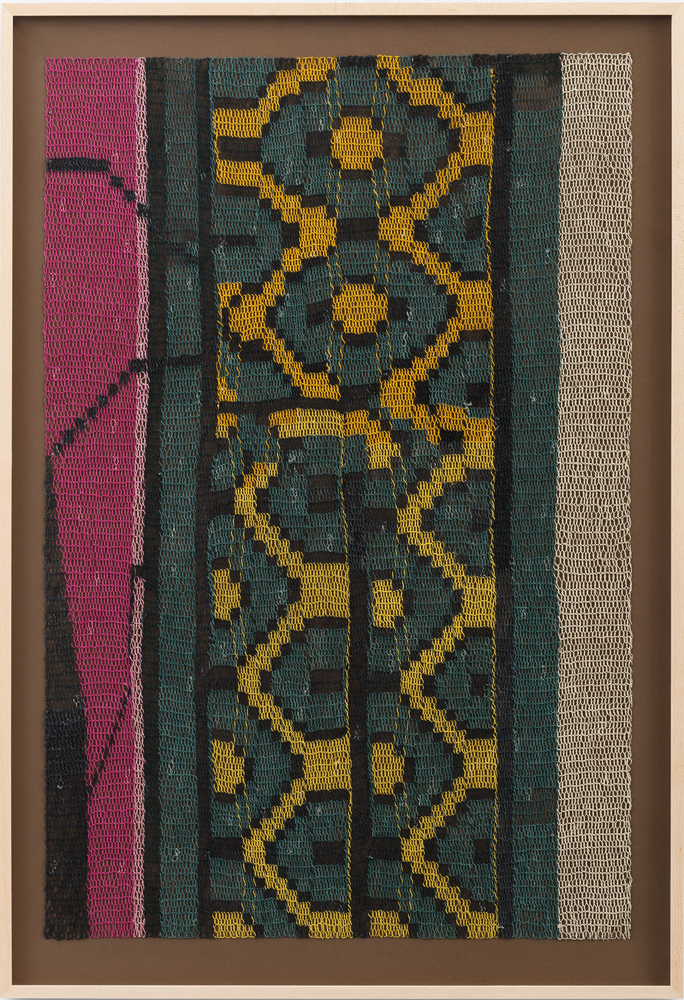
The Event of a Thread
4.4.-31.5.26 / National Gallery of Armenia / Yerevan / Armenia
Artists:
Andreas Exner, Noa Eshkol Eshkol, Uli Fischer, Ruzan Frangulyan, Marcos Grigoryan, Zille Homma Hamid, Heide Hinrichs, Olaf Holzapfel, Christa Jeitner, Davit Kochunts (AHA Collective), Karine Matsakyan, Valentina Maz, Astghik Melkonyan, Eran Schaerf & Eva Meyer, Karen Michelsen Castañón, Lianna Mkrtchyan, Sergei Parajanov, Judith Raum, Samvel Saghatelyan, Silvina Der Meguerditchian, Lucine Talalyan, Tsolak Topchyan, Manan Torosyan, , Ulla von Brandenburg, Elisa van Joolen & Vincent Vulsma, Franz Erhard Walther, Karen Barseghyan, Mariam Aslamazyan along with the „Bauhausraum„, ea visual archive on the history of the weaving workshop of Bauhaus Dessau and Weimar, and historical textiles from the collection of the National Gallery of Armenia
Curators:
Asya Yaghmurian and Vigen Galstyan (National Gallery of Armenia), Susanne Weiß and Inka Gressel (ifa – Institut für Auslandsbeziehungen)
In cooperation with the National Gallery of Armenia and Goethe Institut Armenia
In textiles, tradition meets the present, arts meet crafts, local forms of knowledge meet global relationships. Personal and aesthetic stories connect with those about social and economic conditions. There is hardly a region in which the textiles have not inscribed themselves into cultural and industrial history. Thus textiles also narrate the migration and evolution of materials and techniques.
The exhibition brings together 13 contemporary German-based artists from ifa’s collection in dialogue with 16 artists of different generations from Armenia and the diaspora.
Taking its title from a concept developed by Bauhaus pioneer Anni Albers — who argued that textiles are dynamic entities that enable new cultural realities and reanimate old ones — the travelling exhibition arrives in Yerevan following presentations in Dresden, Kuwait, Istanbul, Beersheba, Limassol, Thessaloniki, Tunis, Prishtinë, Skopje, and Novi Sad. Encompassing a broad range of artistic strategies and socio-cultural concerns, the Yerevan edition places particular emphasis on the issue of textile labour and its gendered politics — challenging the persistent perception of textiles as an apolitical, anonymous, and exclusively feminine realm of social invisibility and domesticity.
Armenia provides a compelling context for these questions. As a key outpost on the Silk Road, and a country whose textile history spans pre-Soviet craft traditions, Soviet industrialisation, and post-independence capitalism, it offers a uniquely asymmetrical vantage point from which to examine the gendered codings of textile-based labour. Working across installation, performance, video, painting and sculpture, the participating artists expose the veiled structures of economic and symbolic production underpinning nationalist, patriarchal, and colonialist framings of the medium.
The exhibition is accompanied by a programme of public talks and a publication.